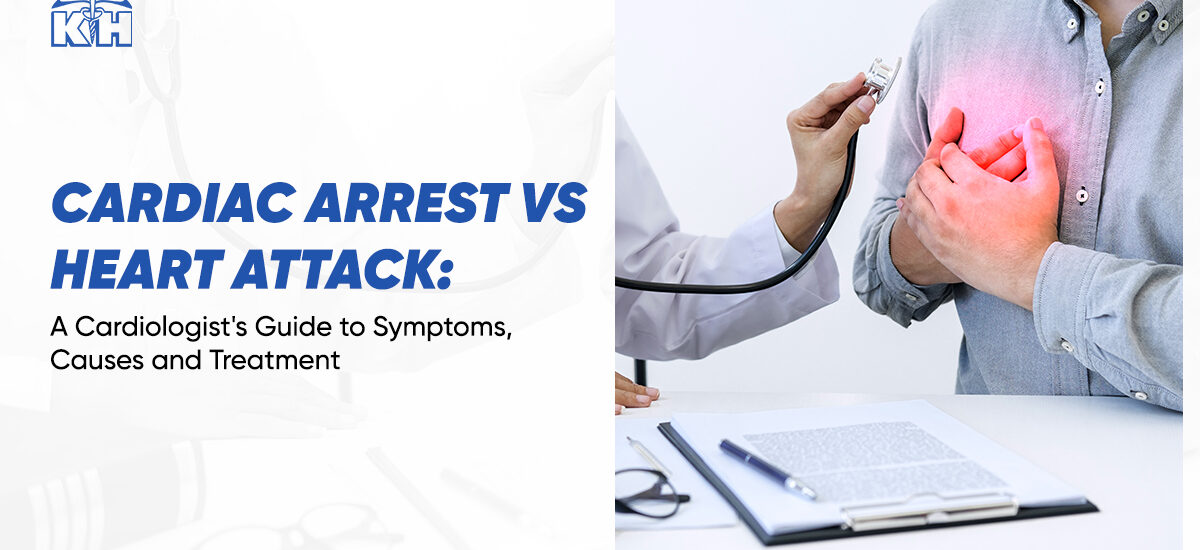
Every year, thousands of lives are lost because bystanders hesitate, unsure of what they are witnessing or what to do. Whether it is a family member clutching their chest or someone who has suddenly collapsed on the street, the right response in the first few minutes is the difference between life and death.
In this guide, the cardiology specialists at Kumaran Hospitals, Chennai break down exactly what sets these two emergencies apart — their causes, warning signs, and what emergency treatment looks like.
What Is a Heart Attack?
A heart attack — medically known as a myocardial infarction — is a circulation problem. It occurs when blood flow to a section of the heart muscle is blocked, usually by a blood clot forming in a coronary artery that has been narrowed by plaque buildup over time.
Think of it as a plumbing blockage. The heart is still beating, but one part of it is being starved of oxygen-rich blood. The longer that blockage persists, the more cardiac muscle tissue dies — which is why the phrase “time is muscle” is used in cardiology.
Common Causes of Heart Attack
- Coronary artery disease (the most common cause)
- High blood pressure and high cholesterol
- Smoking and a sedentary lifestyle
- Diabetes and obesity
- Severe arterial spasm
What Is Cardiac Arrest?
Cardiac arrest is an electrical problem. The heart’s electrical system malfunctions, causing it to suddenly stop beating altogether — or to beat so chaotically (a condition called cardiac dysrhythmia or cardiac arrhythmia) that it can no longer pump blood to the brain and body.
Unlike a heart attack, a person in cardiac arrest loses consciousness almost immediately. There is no pulse. They are not breathing normally. Without intervention within minutes, brain damage and death follow.
Cardiac Arrest Vs Heart Attack: Key Differences at a Glance
| Factor | Heart Attack | Cardiac Arrest |
| Type of problem | Circulation (blocked artery) | Electrical (heart stops beating) |
| Consciousness | Usually conscious | Sudden loss of consciousness |
| Pulse | Present | Absent |
| Breathing | Normal or laboured | Absent or gasping |
| Warning signs | Chest pain, sweating, nausea | Often none (can be silent) |
| Immediate action | Call emergency, rush to hospital | CPR + AED immediately |
Cardiac Arrest Symptoms Vs Heart Attack Symptoms
Recognising the warning signs early is critical. Here is what to look for in each case:
| Heart Attack Warning Signs | Cardiac Arrest Warning Signs |
| Chest pain or pressure (tightness, squeezing) | Sudden collapse without warning |
| Pain radiating to the arm, jaw, neck or back | No pulse or breathing |
| Shortness of breath | Loss of consciousness |
| Nausea or vomiting | Unresponsive to touch or sound |
| Fatigue for no clear reason | Bluish tinge to the lips |
Cardiac Markers and Biomarkers: How Doctors Confirm Diagnosis
Once a patient arrives at the hospital, doctors use cardiac marker tests and cardiac biomarkers — such as Troponin I, Troponin T, CK-MB, and cardiac enzymes — to confirm whether a heart attack has occurred and how much damage was done to the cardiac muscle.
These blood tests are typically run alongside an ECG (electrocardiogram) which detects abnormal electrical activity in the heart. Early and accurate diagnosis is crucial, which is why reaching a well-equipped cardiac facility quickly matters so much.
At Kumaran Hospitals’ AI-enabled Cath Lab, our cardiologists can perform rapid diagnostic catheterisation, angioplasty, and stent placement around the clock — giving patients in Chennai the fastest route from diagnosis to treatment.
What To Do Immediately: Emergency Response
If you suspect a Heart Attack
- Call emergency services immediately — do not drive yourself
- Have the person sit or lie down in a comfortable position
- Loosen tight clothing
- If prescribed, administer aspirin (325mg) while waiting — it helps limit clot growth
- Stay calm and monitor breathing until help arrives
If someone goes into Cardiac Arrest
- Call emergency services immediately
- Begin CPR (Cardiopulmonary Resuscitation) right away — 30 chest compressions followed by 2 rescue breaths
- Use an AED (Automated External Defibrillator) if one is available nearby
- Continue CPR until medical professionals arrive or the person regains consciousness
- Do not leave the person alone
| Kumaran Hospitals Emergency Line For cardiac emergencies in Chennai, reach us immediately at 044-42956777 or +91 86819 56777. Our cardiac team is available 24/7 with ambulance support. |
Treatment Options at the Hospital
For a heart attack, the priority is restoring blood flow to the blocked artery as quickly as possible. This is done through cardiac catheterisation, followed by angioplasty and often stent placement to keep it open. In complex cases, coronary artery bypass surgery may be required.
For cardiac arrest, the immediate goal is to restore a normal heart rhythm. This begins with defibrillation, followed by medications to stabilise the rhythm, and in many cases electrophysiology studies to map the heart’s electrical pathways and identify the underlying cause of the cardiac dysrhythmia.
Learn more about the advanced cardiac procedures available at our Cathlab department and explore our heart and lung transplant services for patients with advanced cardiac conditions.
Prevention: Reducing Your Risk
Both cardiac arrest and heart attack share overlapping risk factors, many of which are controllable. The most impactful steps include keeping blood pressure and cholesterol in check, quitting smoking, maintaining a healthy weight, staying physically active, managing diabetes, and scheduling regular heart check-ups — especially after age 40.
Early detection through a Master Health Check-up at Kumaran Hospitals can identify warning signs before they become emergencies. Prevention is always more powerful — and less costly — than emergency treatment.
Conclusion: Every Minute Matters
The difference between cardiac arrest and heart attack is not just medical terminology — it determines who needs CPR and who needs a catheterisation lab, who needs a defibrillator and who needs an aspirin. Getting this right in the first few minutes can save a life.
If you are in Chennai and have any concerns about your heart health, the cardiology team at Kumaran Hospitals is here for you. Book an appointment today — don’t wait for a warning sign.